
Shelving Safety: Retrofit vs. Replace Aging Shelving
If your shelving has been around since Y2K, there is a good chance it is still “working.” It is standing. It is holding boxes. It might even look fine from a distance.
That is exactly why shelving safety gets ignored.
Older shelving rarely fails all at once. It degrades. Rust shows up. Shelves bow. Brackets loosen. Welds fatigue. Hinges seize. And the longer you delay a safety check, the more likely you are to spend money in the wrong place, either retrofitting something that should be replaced, or replacing something that had plenty of safe life left.
This is a retrofit vs replace decision, but it should start with one priority: shelving safety.
The three options everyone has, and the one most people choose
If your shelving is aging, you have three choices:
- Ignore it and hope it holds
- Retrofit and extend the life 5 to 10 years
- Replace it entirely
Most facilities guess. Some retrofit when they should replace, and they introduce a safety risk. Others replace when a well-scoped retrofit would have bought years of reliable use.
The decision comes down to structure, load, age, and use. That is what determines whether you can improve shelving safety by upgrading components, or whether you need a new system.
Shelving safety starts with the frame, not the shelves
The single most important question is whether the structure is sound.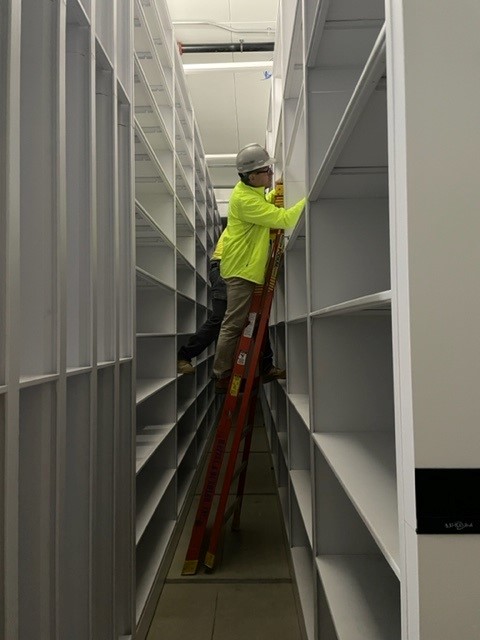
A retrofit is extending life on a sound frame. It only works when the “skeleton” is good. If the frame is compromised, no amount of new shelves or hardware fixes the underlying safety issue.
Think of it this way:
- If shelves and hardware are failing, you may be able to retrofit safely
- If the frame is failing, replacement is usually the safest move
This is the core of shelving safety decisions.
When retrofit improves shelving safety and makes financial sense
A retrofit makes sense when you can restore safe performance by replacing components while keeping a sound structure.
Retrofit is typically the right call if:
- The structure is sound with no major rust, cracks, or deformation
- Shelves and hardware are the main problem, like bent shelves, worn hinges, corroded locks, or damaged fasteners
- Load and use patterns have not changed dramatically since installation
- The system is in the 8 to 15 year range and you want another 5 to 10 years safely
- Retrofit cost is well below replacement cost, often framed as less than 40 percent of replacement
- You can still meet safety and compliance expectations with upgrades
If those conditions are true, retrofit can be the fastest way to improve shelving safety without a full teardown.
Retrofit options that improve shelving safety quickly
Not all retrofits are equal. Focus on changes that improve stability, reduce failure points, and restore predictable performance.
Common retrofit work includes:
- Hardware replacement, including hinges, locks, handles, and fasteners, often one of the most visible improvements
- Shelf replacement, keeping the frame while replacing bent or corroded shelves with new coated, composite, or steel shelves
- Refinishing and sealing, treating rust and recoating surfaces to prevent continued corrosion
- Bracing and reinforcement, adding supports to reduce sag and improve stability
- Upgrading hinges and locks, especially in humid or high-use environments where hardware fails first
These are practical ways to extend life while improving shelving safety.
When replacement is the safer and smarter choice
Replacement is usually the right call when safety cannot be restored without rebuilding the core structure.
Replace if:
- The structure is compromised with visible rust on the frame, cracks in welds, deformation, or flex in uprights
- Load capacity is inadequate for current use and shelves bow under today’s load
- Safety or compliance requirements cannot be met without a new system
- The system is 20 years old or more and material fatigue is a real concern
- Multiple system components are failing at once, pushing retrofit costs toward replacement
- Total retrofit cost exceeds roughly half of replacement cost
- The environment has changed significantly, such as higher heat, humidity, chemical exposure, or different safety requirements
If any of those are true, replacement is often the most defensible shelving safety decision.
The shelving safety audit: what to look for in 15 minutes
 You do not need a full engineering study to spot obvious red flags. Start with a quick inspection and escalate if you see problems.
Frame integrity
- Visible rust on uprights or primary joints
- Cracks in welds or frame members
- Frame flex when you push on it
- Bent or loose corner braces
- Rust staining or weeping from welds
Load and stability
- Shelves sagging in the middle, even lightly loaded
- Gaps between shelf and support bracket
- Significant deflection under load
- Shelves permanently bent
Safety and compliance
- Aisles, egress, and storage height that no longer align with current expectations
- Accessibility concerns where reach height is unsafe or impractical
- Hazards like sharp edges or protruding fasteners
This is the minimum standard for shelving safety triage.
A simple decision framework that prevents bad calls
If you want a quick way to get out of the “guessing” zone, evaluate three things:
- Frame structural condition
- Component failure rate
- Age
When the frame is sound and failures are limited to components, retrofit often makes sense. When the frame is compromised or the system is very old, replacement is usually the safer call.
If you retrofit, do it safely
A retrofit should improve shelving safety, not create new risks.
A few things to not skip:
- Empty the system fully before work begins
- Assess the full system before replacing parts, so you do not discover frame rust mid-project
- Document replacements and load adjustments for future maintenance
- Test after retrofit, including load behavior and stability, before reloading
- Schedule during low-use periods to reduce operational disruption
Shelving safety is cheaper than shelving failure
A safety check costs less than a collapse, an injury, or a rushed replacement.
If your shelving is old enough to have survived Y2K, it is time to inspect it, score it honestly, and decide whether a retrofit will safely extend life or whether replacement is the smarter move.
Request a retrofit vs replace assessment focused on shelving safety. We will inspect the system, evaluate the frame and components, and give you a clear recommendation based on structure, load, age, and use.