
Spring Cleaning Is Not a Storage Strategy
Spring cleaning feels productive, but is it an actual storage strategy? You purge a few boxes, straighten shelves, and finally reclaim an aisle you have not seen in months.
Then the week gets busy, deliveries keep coming, files keep piling up, and the clutter returns. Not because your team did not try hard enough, but because cleaning does not fix the storage system.
If you want lasting improvement, you need a storage strategy. That means space planning, optimizing the layout, selecting the right storage methods, and designing how materials move through the space so the system stays efficient long after the “clean” feeling fades. O’Brien Systems approaches storage this way through consultation, workflow analysis, and layout design built around how your operation actually runs.
Why spring cleaning keeps failing
Most storage spaces do not get messy because people are careless. They get messy because the layout forces bad behavior.
Here is what spring cleaning cannot solve on its own:
-
There is not enough capacity where it is needed most, so overflow becomes permanent.
-
Items do not have a defined home, so “temporary” becomes the default.
-
The travel path is inefficient, so people stage items in the nearest open spot.
-
The space is not designed for the wa y materials are received, stored, retrieved, and returned.
In other words, the problem is not the mess. The problem is the missing storage strategy.
A storage strategy gives your space a job
A storage strategy is not only about fitting more shelves into a room. It is about aligning storage with the workflow.
O’Brien Systems evaluates current storage methods and designs more efficient systems, including onsite consultation and AutoCAD layout review. That planning work is what turns a room from “where things go” into a space that supports productivity and safety.
And it matters across environments. Office and facilities teams want accessible, organized storage that does not disrupt daily operations. Warehouse and industrial teams need high-capacity systems that reduce time, risk, and errors as volume grows.
A simple storage strategy guide that holds up
If you want a practical way to approach storage optimization, start here.
Step 1: Define what is being stored and how it is used
What are you storing today? What is growing? What gets touched daily versus weekly or quarterly? A storage strategy starts with the inventory and the access frequency, not the floor plan.
Step 2: Map the workflow
How do items enter the space? Where do they go first? Who needs access, and how quickly? We perform workflow analysis by examining how documents and materials flow through an organization, including how they are created, stored, and retrieved across their lifecycle.
Step 3: Identify your constraints
Ceiling height, obstructions, and safety requirements shape what is possible. For high-density mobile systems, we consider layout and safety details like ceiling height and room obstructions, and provides an AutoCAD plan for review by life safety personnel and end users.
Step 4: Choose the right storage method for the job
This is where most cleanup efforts fall apart. If the storage method does not fit the materials and the workflow, the space will drift back to overflow.
A few examples that support an effective storage strategy:
-
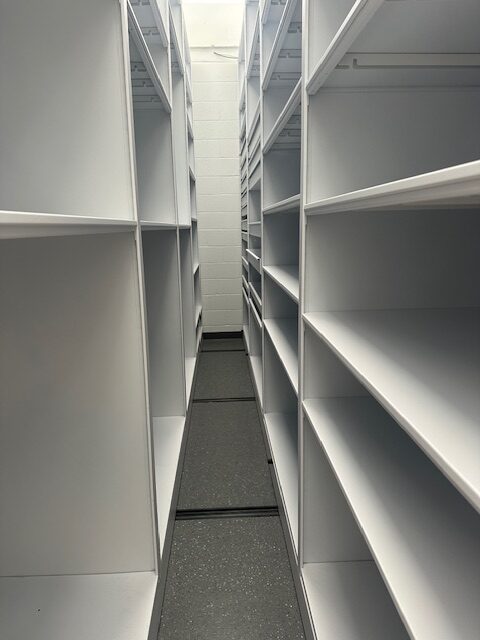
High-density mobile storage can increase capacity by doubling storage units in the same square footage, and can reduce or eliminate the need for an addition by better utilizing existing space.
-
Static shelving can maximize floor space by assessing existing floor space and building a custom solution, including heavy duty applications.
-
Warehouse automation can help cramped spaces and disorganized shelves by approaching the space differently, with solutions designed to reduce human error and increase productivity and safety.
Step 5: Pressure test the layout for real life
A layout that looks good on paper still needs to work on a Monday morning when three people need access at the same time. A storage strategy includes access zones, staging areas, and aisle space based on actual use, not best-case behavior.
Step 6: Make it sustainable
The goal is not a perfect room on day one. The goal is a storage strategy that still works when volume grows and priorities shift. That is why flexibility matters in storage design, especially when needs change over time.
Office and facilities: build a storage strategy around access and consistency
For office and facilities teams, storage issues often show up as time loss and frustration.
A storage strategy helps you:
-
Reduce walking and searching time by zoning frequently accessed items.
-
Improve accessibility by matching storage height and layout to the users.
-
Maintain order by designing a clear return-to-home process.
High-density mobile storage is often a fit when volume is growing and expanding is costly, because it can increase capacity while reducing wasted space.
Warehouse and industrial: build a storage strategy around speed, accuracy, and safety
In warehouse and industrial environments, storage is directly tied to productivity. When layouts are inefficient, picking slows down and errors increase.
A storage strategy supports:
-
Faster retrieval and better flow through improved layout design.
-
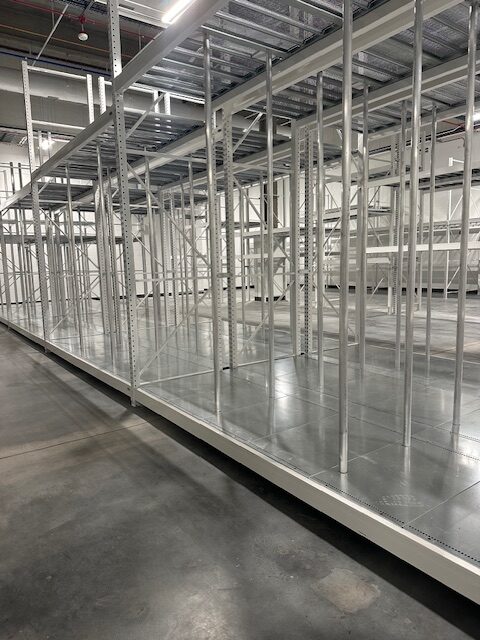
Better use of available footprint with high-capacity systems.
-
Reduced risk through safer storage and retrieval processes.
O’Brien Systems highlights that material handling and warehouse operations depend on making the best use of space, and points to automation and better storage systems as a difference-maker for productivity and safety.
Storage strategy and ROI: what to measure
If you want to justify changes, measure what the current layout is costing you.
A practical storage strategy ROI lens includes:
-
Space ROI: How much square footage can be reclaimed or avoided? High-density storage can reduce the need for an addition by better utilizing existing space.
-
Time ROI: How long does it take to retrieve, return, and audit? Workflow analysis focuses on the flow of materials through their lifecycle so inefficiencies can be removed.
-
Accuracy ROI: Where do errors happen and why? In warehouse environments, automation is positioned as a way to reduce human error and increase productivity and safety.
The point is not to buy storage for storage’s sake. The point is to invest in a storage strategy that pays back through speed, consistency, and better use of space.
Spring cleaning can start the conversation, but it cannot finish it
Cleaning helps you see the problem. A storage strategy solves it.
If you are ready to move beyond the seasonal reset, O’Brien Systems can help you evaluate current storage methods, analyze workflow, and design a storage strategy that maximizes space and improves daily efficiency.
Ready to optimize your space? Contact us to request a space planning consultation and layout review.